Alastair Chisholm on Letting the Kids Be the Parents and Why Editing Is Like Time Travel
When writing a book, something many people recommend (and others utter dire warnings against) is reading a bunch in your specific genre to get a feel for how successful authors are doing it. Additionally, kidlit authors need a clear sense of how to write for their particular age group.
Also: comps. Knowing what other books to compare your book to? Very important. You like the adventure and relationships of Percy Jackson? Imagine a sci-fi version! Sort of. Really into the snarky, mildly emo tone of Aru Shah? That but with gadgets and robots and time travel… if you squint.
Noticing a bit of a trend? Middle grade science fiction comps are hard! So there was a period during the writing of Future Me and the VR Prison when I sought out every highly-rated middle grade sci-fi novel I could find.
I’m still not sure I’ve found great comps for my book and series in the literary world. There’s a reason I pitch it as techie Goonies meets Terminator at sci-fi Hogwarts — and it’s not just the name recognition. What I’m doing doesn’t seem to exist… which is both awesome and terrifying. What I did find, though, was a ton of really smart, emotionally resonant science fiction works about tweens and teens.
Alastair Chisholm’s Orion Lost is one of the best of those, with characters you want to root for, problems that seem far too big for a group of kids to solve alone, and the best kinds of twists — the ones that hide in plain sight. So I was super excited when he responded to my request for an interview, and even happier with the results. I hope you are, too.
Here he is on Orion Lost, writing, and what’s next.
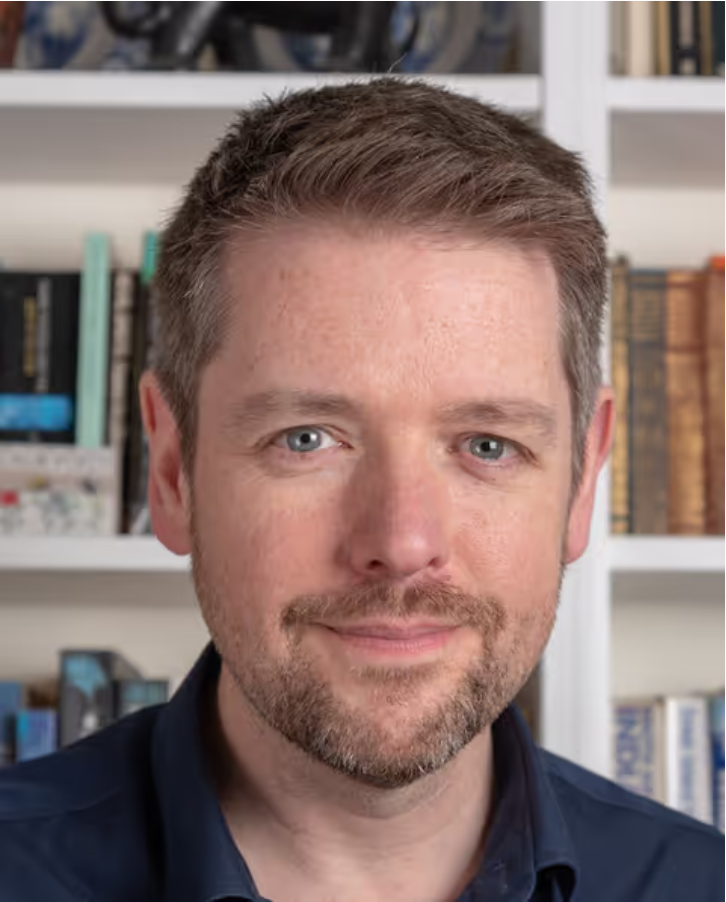
1. While many writers “pick a lane” and stick to it, you write across widely different age ranges, from delightfully silly picture books (Inch and Grub) to high-octane middle-grade sci-fi. Does writing one serve as an antidote to the other, or do you have to completely rewire your brain between projects?
I love writing across the age ranges, and luckily I find it quite easy to switch. I could be writing one thing, getting edits for another, and pitching a third, all on the same morning!
2. I’ve read that before writing full-length sci-fi novels, you worked extensively with tech, coding, and creating Sudoku and logic puzzle books. How did that analytical mindset translate into plotting fiction? Do you treat the architecture of a mystery or the tech on a colony ship like a solvable logic grid?
I’ve found there’s a surprising overlap with computer programming and writing – or plotting, at least. In both cases, I’m trying to imagine a world where certain things happen. In programming, it’s how the code will interact with its environment – screen, hard drive, data, etc. In storytelling, it’s the characters and their challenges. You need to set them up so that the story seems to just happen. When you manage it, it’s very much like finding the solution to a puzzle.
3. What does your drafting and problem-solving routine look like? When you run into a plot dead-end or mechanical question, do you outline your way out with diagrams, or do you dive into the prose and write through it discovery-style?
I’m a plotter – I like to know where I’m going. Sometimes I’m wrong, of course – as I start writing, my characters might take me in another direction! But mostly I like to think I know the plan. So I fill dozens of notebooks with ideas and scraps of ideas beforehand, and do my problem-solving there.
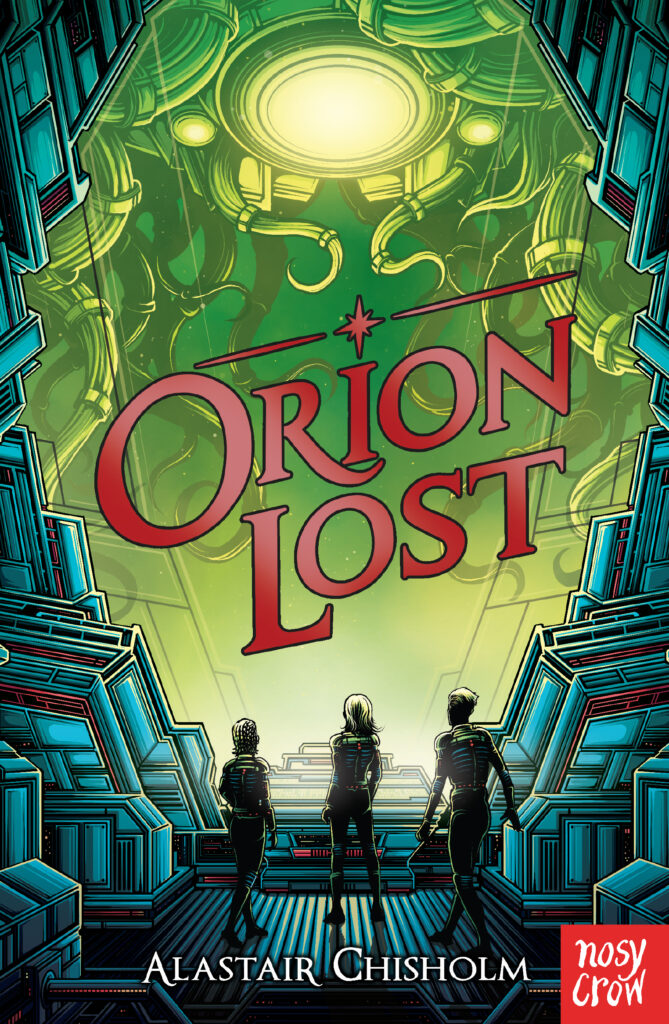
4. A classic trope of middle grade fiction is getting the adults out of the room so the kids can drive the plot. But in Orion Lost, you do something more nuanced: the adults are physically present right behind the glass in cryo-sleep. How did that constant visual reminder of their helpless parents shape the emotional pressure on Beth and the crew, compared to a story where the adults simply vanish?
I wanted to show that the situation had swapped – the kids aren’t just trying to get home, they’re now responsible for everyone else, almost as if they’d become the parents. It was all about that responsibility. So having the adults be there, but helpless, was very much part of it.
5. When Beth is thrust into the role of captain, it creates immediate friction with Vihaan, whose father was the original captain. Despite this, you avoid turning him into a mere antagonist for her. What were you hoping to explore with each character’s journey?
Orion Lost was my first children’s novel, and I spent a while thinking about the books, plots and tropes I liked or disliked at that age. I always liked books with ordinary kids – not perfect, not awful, just trying to get by. And I hated the idea of the “baddy” kid, the one who was just mean all the time for no real reason. I wanted my heroes to be normal. They’re not goodies or baddies. Anyone reading the book could be on that ship. Vihaan is arrogant and entitled, but he’s also competent and he cares about doing the right thing. His journey is about learning to recognise his own failures. Beth’s is about building the confidence to be able to take command and see him as an asset, not a threat.
6. The ship’s AI, Ship (which is a fabulous name), and the various mechanical subsystems play as much of a role in the story as any human crew member. How did you approach designing the Orion so that troubleshooting life support, fuel levels, and computer code felt just as suspenseful as something like an external laser firefight?
This was definitely an area where my techie background helped! I had a pretty good idea of the kinds of things that would be easy or hard, and how Ship might balance a ‘human-like’ nature with its core code. When it came to the design of the ship itself, I actually looked at cruise ships. They have to solve a lot of the same problems in terms of food, accommodation, things like that. I scaled everything up and added gravity, oxygen, and rockets 😀
7. One of the most chilling lines early in the book is the realization that “someone is lying to them.” With this acting as a sort of closed-room space mystery, how did you balance seeding clues and tech readouts so sharp young readers could guess the truth without giving away the twist too early?
Editing. Editing is brilliant. When I teach creative writing, I always stress just how wonderful it is to be able to go back and drop in clues, fix issues, spot inconsistencies. It’s like time travel, and it makes you look much cleverer than you actually are!
8. The external threats (the Videshi and space pirates) force the kids to confront issues far bigger than basic survival, touching on resource harvesting and inter-species ethics. How do you approach weaving serious ethical questions into a middle-grade thriller without losing momentum?
For me, it’s often the other way around – I have the human story I want to tell, and the plot is there to set it up. I love the whizz-bangs of thrillers, the explosions and pew-pew-pew lasers, all that good stuff – but the stories you remember are the ones where you care about the people. So every thriller point I added was there to make the reader care about Beth and the others, and feel how they would feel.
9. Looking back at drafting Orion Lost, was there a specific scene, technical dilemma, or character clash that went through multiple rewrites before you finally cracked it?
It was certainly challenging working out how they would escape at the end! I had a few ideas, but I remember when the final piece fitted in and I suddenly realised I had it.
But don’t be fooled, this is about editing again. Even after the first draft, there were many changes. Some characters disappeared altogether! Some plot points were tweaked or added or removed. My editor at Nosy Crow, Tom Bonnick, was amazing at helping me with this. Remember – editing makes you look clever!
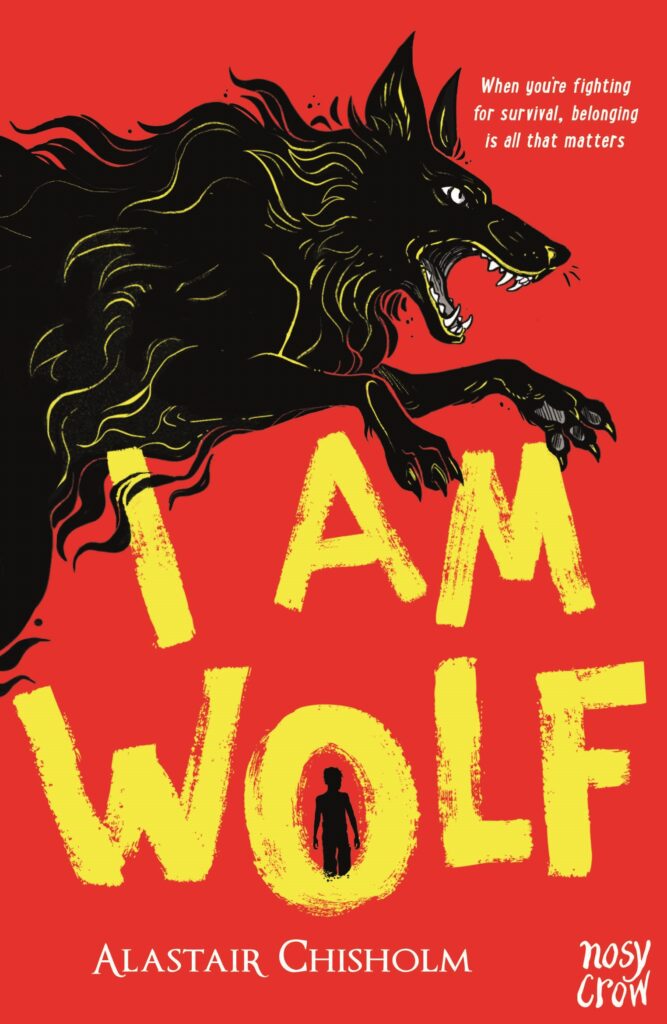
10. In novels like Adam-2, The Consequence Girl, and I Am Wolf, you continue to explore artificial intelligence, war, and the loss of individual autonomy. What is it about technological dystopias and philosophical sci-fi questions that keeps pulling you back as a storyteller?
We only care about stories if we care about the people in them. Those people could be humans, robots, small furry animals, whatever – but they’re what really matters. So, I usually start with that. Adam-2 started with a ‘boy’ in a basement, apparently trapped there for years. I imagined who he was, what he was, and why he would be there, and the story came out of that. I Am Wolf came from the title, which popped into my head – I knew that the person saying this really cared about that statement. It was their life. Why? The Consequence Girl was a girl on a snowy mountain…
Once I know who these people are, and how they feel, I can see how the different sci-fi or philosophical ideas might flow from them. But it starts with them.
11. As someone currently in the midst of a sci-fi series, I’m curious both why your first several science fiction novels are standalones and if there is anything about the genres that led to Dragon Storm (a fantasy) being your first series. Related: do you have a preference between writing series vs. standalone works?
In its first incarnation, Orion Lost was actually the first volume of a trilogy, but my editor asked if it could be a single book. There are some boring, commercial reasons for this. Bookshops are wary of trilogies from new authors. They need shelf space for three books instead of one. They know trilogies go down in volume (book 2 sells less than book 1, 3 less than 2). And the author is an unknown quantity – will they even finish the trilogy?
But standalone books also force a discipline on you as an author. You can’t sprawl. You can’t just hope you’ll have worked out the tricky plot issues by book 3. You have to keep the story tight, beginning-middle-end, and work out what really matters to you.
The Dragon Storm series was a little different, because the books share the same world but can be read in any order. So a kid could go into a bookshop and just pick up one that spoke to them. They didn’t have to commit to reading everything.
Recently, I’ve had the chance to write an actual trilogy starting with I Am Wolf. I loved the scale of it! But still, I think it’s critical that when a reader picks up a book, they get a complete story. It might be part of a trilogy, but it has to be complete in itself.
12. What’s next on your creative to-do list? Are there new worlds, sequels, or different genres you’re currently working on?
I am very busy right now! I have a non-fiction picturebook coming out next year, Tiny Voyager, Mighty Mission, about the amazing Voyager 1 Space Probe. I’m very excited about that! And I’ve just completed my first YA novel, a fantasy dragon story (I seem to be drawn to dragons). And there are some more middle grade books coming too… I’m having a wonderful time!
You can learn more about Alastair Chisholm here.